

Stack Play #1: The S-Corp Strategy for High Earners
Whether You're Self-Employed, Have a Side Business, or Both

You make good money. Maybe great money.
You might run your own consulting practice. You might be a full-time freelancer, a solopreneur, or a contractor who hasn’t had a W-2 in years. Or maybe you have a corporate job and a growing side business.
Either way, you’re earning well. And every April, you write a check that makes your stomach turn.
You look at your effective tax rate and think: There has to be a better way.
There is. But it’s not a deduction hack or a crypto loophole. It’s a structural change—one that reshapes how your income flows before it ever hits your personal return.
This is Stack Play #1.
The Situation
This play is designed for two types of high earners:
The Full-Time Self-Employed Professional:
Consultants, freelancers, coaches, advisors, creatives, or agency owners
Earning $100K+ annually through your own business
Filing taxes as a sole proprietor or single-member LLC (Schedule C)
Feeling the full weight of self-employment tax on every single dollar
The W-2 Professional with Side Income:
Full-time employment at $150K+ with consulting, advisory, freelance, or business income on the side
Side income of $50K+ annually
Also filing that side income on Schedule C
Both profiles share the same structural problem: no tax architecture between you and the IRS.
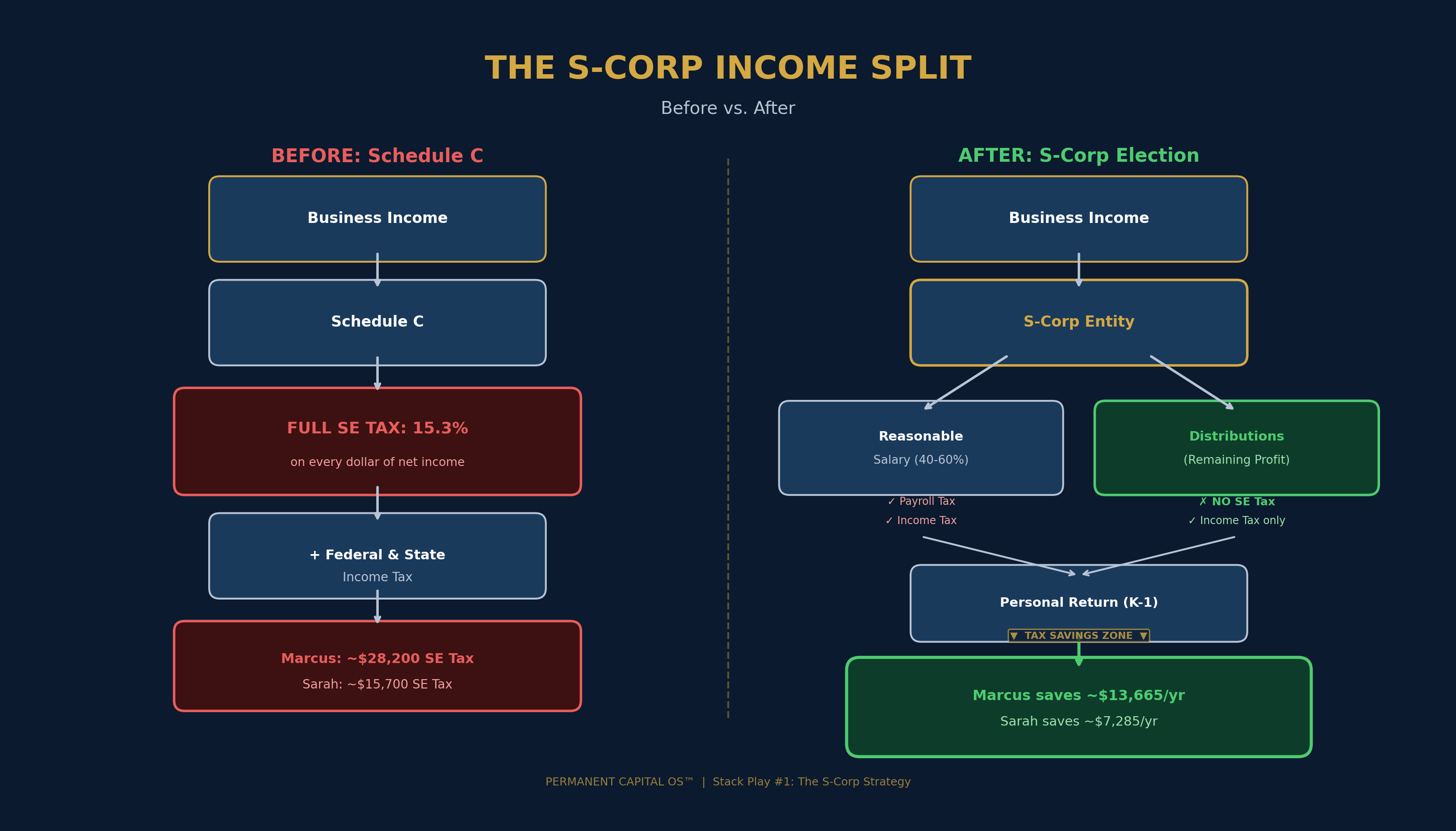
Here’s the math: On $150,000 of Schedule C income, you’re paying approximately $21,068 in self-employment tax (15.3% on 92.35% of net earnings) before federal and state income taxes even enter the picture. The Social Security portion (12.4%) applies to earnings up to $184,500 in 2026, and the Medicare portion (2.9%) has no cap—plus an additional 0.9% Medicare surtax kicks in above $200,000 for single filers ($250,000 married filing jointly).
For the fully self-employed, this is even more painful. If you’re earning $200K with no W-2 employer splitting FICA with you, you’re shouldering the entire 15.3%—both the employer and employee halves. That’s not a rounding error. That’s a car payment going to a tax you could legally reduce.
